From Catchphrase to Common Speech: How New Expressions Travel
How new expressions travel depends on who borrows them, where they appear and what they do there. Track those clues to distinguish reuse from routine.
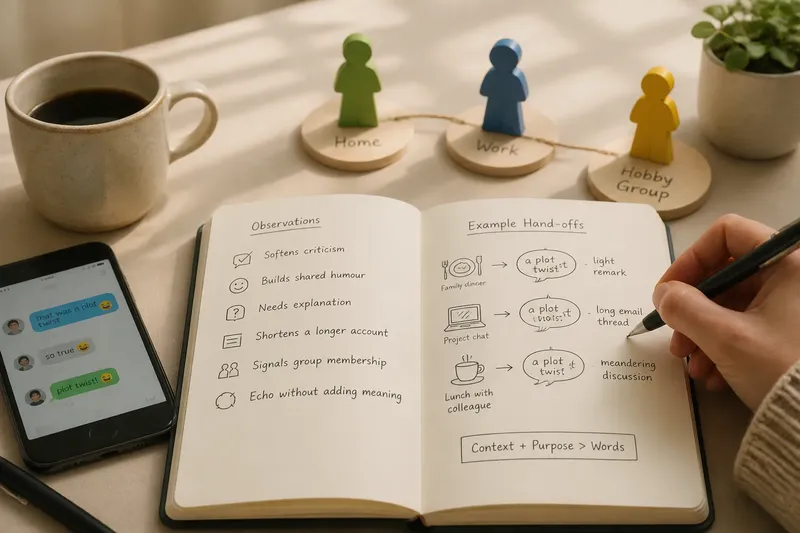
At a family dinner, someone calls a minor kitchen mishap “a plot twist”; the next morning, a colleague uses the same phrase in a project chat. How new expressions travel is easier to understand when you follow the social hand-offs, not just the wording. Each speaker decides whether the phrase fits their own conversation.
A phrase earns its place by doing a job
People borrow expressions when they help with a particular social task: easing a complaint, sharing a joke, acknowledging an awkward moment or describing something that would otherwise take longer to explain. “A plot twist” can make an unexpected change sound playful rather than alarming.
When you hear an unfamiliar phrase, note what the speaker is doing with it. Is it replacing a longer description, softening a disagreement or signalling a reference that others are expected to know? The answer explains more about its usefulness than simply recording where you saw it.
- Observation: the phrase makes a criticism sound gentler. If speakers use it to keep a conversation friendly, then record its role as a softener; otherwise, note whether it is being used for another purpose.
- Observation: listeners respond with laughter or a matching joke. If the exchange builds shared humour, then mark it as playful; otherwise, check whether the phrase was meant literally.
- Observation: a speaker pauses to explain a reference. If the explanation is needed, then note that the phrase still depends on specific context; otherwise, record that listeners already understand it.
- Observation: the expression replaces a longer account. If it conveys the situation clearly, then note its shorthand function; otherwise, record that the speaker added details to make the meaning clear.
- Observation: people use the phrase to show familiarity with a group. If others recognise the cue, then note its membership signal; otherwise, record that it did not establish shared knowledge in that setting.
- Observation: someone repeats the phrase without connecting it to the conversation. If it adds no meaning, then treat the instance as a reference or echo; otherwise, record the specific point it helped communicate.
These observations describe a phrase’s current use, not its future. A line that works well among friends may remain local, while one that solves a common conversational problem may be easier for others to borrow.
Each hand-off changes the social setting
Expressions often move through people who already share some connection: friends, relatives, colleagues, club members or neighbours. A listener can copy the wording because the surrounding conversation supplies its meaning, without needing a formal explanation.
Imagine a book club uses “the scenic route” for a discussion that wanders pleasantly away from its subject. A member uses it at lunch with colleagues, adding a brief explanation; one colleague later applies it to a meandering email exchange. The phrase has moved between settings, and its use now describes a different kind of conversational detour.
To keep a useful note, write down the setting, the speaker’s purpose and whether anyone needed an explanation. “A colleague used it to describe a long email thread” is more informative than a bare quotation because it records what the words did in that new setting.
Online repetition can preserve wording without spreading use
A post, clip or comment can introduce a phrase to people outside its first community. A caption may carry enough context for someone to understand the wording, but seeing it repeatedly does not mean they will choose it in an unrelated conversation.
Separate direct communication from references to the source. Someone using a phrase to describe their own situation is doing something different from reposting a joke that contains it. The wording may be familiar in both cases, but only the first shows how it works beyond the original piece of content.
Compare the settings rather than counting appearances. If a phrase shows up in a family message, a work conversation and a hobby group with different uses, you have evidence of varied borrowing. If it appears in several reposts that all point back to the same joke, its circulation may still depend on that source.
Borrowing carries context as well as words
A phrase can be bound to a community’s shared history, humour or identity. Someone outside that setting may repeat the words without knowing what gives them their force. Before using an expression that feels pointed or unfamiliar, check how people in its originating community use it and whether they have asked others to avoid it.
Meaning can shift as new speakers adapt a phrase to their own relationships. A term once used affectionately within a group, for instance, may sound insulting when applied by outsiders. If the context is unclear, choose ordinary wording instead of relying on a viral explanation.
When quoting a phrase in public, mention where you encountered it if you know. That small detail can preserve some of its context without pretending you know its full history or claiming it as your own discovery.
What signs show that a phrase is being borrowed?
How can I tell whether an expression is used beyond its first circle?
Notice whether people in separate social settings use the phrase to communicate something of their own, rather than merely quoting the same source. Record the context and purpose each time, since recognisable wording alone does not show how widely it is being adopted.
Does repeated online exposure mean people use the phrase in conversation?
Not necessarily. Look for people choosing the expression in messages or speech about a fresh situation, rather than sharing content that already contains it.
Why does a phrase take on a different meaning?
New speakers adapt words to their own relationships, humour and circumstances. That adjustment can make the phrase useful in a new setting, though it can also detach it from the associations it carried in its first community.
When should I avoid repeating an unfamiliar expression?
Pause if you do not understand its reference, if it seems to target a group, or if people connected to its original setting have objected to its use. Choose a clearer, neutral phrase until you understand the context.
Some expressions remain local or fall out of use
A phrase may depend on a passing joke, an event or a particular online format. When that context loses its relevance, people may stop using the words, or keep them within a smaller circle where the reference still makes sense.
Describe what you actually observe: a phrase may be visible in posts, used in conversation or woven into a group’s routine. Those are different kinds of evidence, and one does not automatically lead to another. A phrase can stay familiar as a reference without becoming a convenient part of everyday speech.
For a clearer account of how new expressions travel, keep a brief record of the words, setting, purpose and any shift in meaning. When you hear the phrase again, compare what it does in that conversation with what it did before. The useful clue is not simply that the wording survived, but that someone found a reason to make it their own.