How to Observe Urban Sketching at a Saturday Market
Observe urban sketching at a Saturday market with a clear note-taking method that separates visible activity from assumptions about its setting.
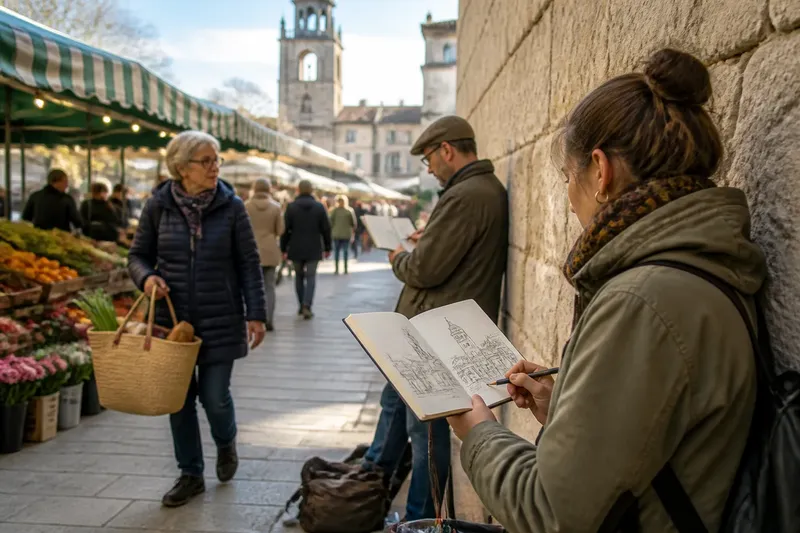
A woman opens a pocket notebook beside the market’s flower stall, while a shopper pauses to let her pass. To observe urban sketching in a public place, start with those practical details: where people settle, how they make room and what the activity asks of the surroundings.
Imagine you have come to buy fruit and notice sketchers near the square’s stone wall. Your task is to describe how they use the market, not to decide how popular the pastime is. A focused field note can show the relationship between drawing, the market’s layout and the needs of people passing through.
Map the market before interpreting the gathering
Choose a public spot where you can stand without blocking a path or staring at anyone. Note nearby features that may matter to sketching: benches, shelter, a clear view, the width of the walkway and the flow of shoppers. Write down what is present before deciding why participants chose it.
Keep observations separate from explanations. “Two people draw facing the clock tower” describes what you can see; “they meet here every week” is a claim that needs a different source. A simple note with two headings—“Observed” and “Unclear”—helps keep those apart.
For a market visit, check these details and let each result guide your next action:
- Observe whether sketchers stand or sit; if they use benches, note which areas offer seating, but if seats are occupied, record where they work instead.
- Observe whether bags or notebooks extend into the walkway; if they obstruct shoppers, note the pinch point, but if the path stays clear, record how participants keep their materials contained.
- Observe whether participants choose a sheltered spot; if they do, note what cover the market provides, but if they work in the open, leave shelter out as an explanation.
- Observe whether they face a landmark or a stall; if they share a view, note its visible features, but if their subjects differ, describe the separate choices.
- Observe whether conversation interrupts drawing; if participants pause to talk, note when it happens, but if they work quietly, do not infer that they are strangers.
- Observe whether shoppers can move past comfortably; if people need to detour, note the location, but if traffic flows freely, record the arrangement that leaves room.
- Observe whether the activity changes as stalls open or pack away; if it does, note the timing of the change, but if it does not, avoid attributing the drawing session to market routines.
Stay in public areas, avoid recording private conversations and do not photograph identifiable people without permission. The market is a shared workplace and shopping space as well as a setting for drawing; your notes should not make other users feel watched.
Trace the drawing routine through the space
Watch the activity’s sequence from a respectful distance: arrival, choosing a viewpoint, preparing materials, drawing and leaving. You do not need to follow anyone around. Notice how the routine fits within the spot where you are standing.
Say you see one sketcher arrive with a small notebook and pencil, then choose a position beside the wall. A second person comes over, greets them and sets up a few paces away. The visible details support a description of a shared arrival and a nearby working arrangement; they do not, by themselves, establish a regular club.
Pay attention to what is needed to begin. Paper and a pencil are visible in this scene, but another participant may use different materials. Note what you can see without treating one person’s equipment as a rule for everyone.
Look at how participants adjust to ordinary market activity. Someone may shift closer to the wall when shoppers pass, or hold a notebook rather than spread supplies across a bench. Those choices describe how drawing shares space with the market’s daily use.
Notice how the market shapes the drawing session
A market offers changing subjects: stall signs, rooflines, crates and people moving through the square. The useful question is not whether the market is an ideal place to draw, but which of its actual features participants make use of.
Think of a drawing spot like a coat hook beside a door: its value comes from fitting neatly into a routine. A wall may provide a stable place to lean, while an open view gives a sketcher room to see the square. Record the specific feature in use rather than assuming that every convenient feature explains the choice.
Consider the competing needs of the setting. A busy path may offer an interesting view but little space to stand; a bench may be comfortable but already in use. Describe who can move through the area and whether participants adapt their positions. Avoid guessing at anyone’s reason for choosing or leaving a spot.
What can a short market visit tell you?
How can you tell whether the sketchers arrived together?
Look for visible coordination, such as greetings, shared preparation or one person making room for another. People drawing in the same place may still have arrived independently, so record the interaction rather than assigning them a group identity.
What makes a market spot workable for drawing?
Note the view, space to stand or sit, shelter and how easily shoppers can pass. Only describe a feature as useful to participants if you can see them using it or they explain its relevance.
How should you record a newcomer’s first interaction?
Write down the observable exchange: who spoke, what visible invitation followed and whether the newcomer began drawing or moved on. If no newcomer appears, state that you did not observe one rather than deciding how easy it is to join.
When is it appropriate to ask a participant a question?
Wait until someone is not concentrating, serving a customer or having a private conversation. Ask one brief, non-leading question, accept a refusal, and keep the answer distinct from your own observations.
Work through one market visit without overclaiming
Imagine a visit with these clearly hypothetical starting inputs: you arrive at the square after the stalls have opened; two people are drawing beside the wall; one uses a pocket notebook, the other holds a sheet of paper; shoppers pass behind them without detouring; and you do not know whether they planned to meet.
First, write the observed scene: two people draw beside the wall, using different paper formats, while shoppers pass behind them. Second, note the setting detail that is visible: the wall gives them a place to stand beside, and their materials remain in their hands rather than across the path. Third, record the unanswered question: their arrival and interaction do not tell you whether this is a planned meeting.
Next, consider the tradeoff. The wall gives the sketchers a stable position, but the nearby flow of shoppers means their space is limited. Because the path remains clear in this imagined visit, your account can say they worked beside market traffic without obstructing it; it should not claim that the market is always suitable for sketching.
The resulting description is specific but bounded: “Two people drew beside the market wall with portable materials as shoppers passed behind them. Their work left the path clear, though whether they had arranged to meet was unclear.” That is the answer supported by the stated observations, not a verdict about the wider market or the pastime’s reach.
Write an account grounded in the place
Build your note around three things: the market feature participants used, the way drawing fitted around other activity, and what remains uncertain. If you speak to someone, identify their explanation as their own account rather than presenting it as a view shared by everyone.
For example, you might write that sketchers used a wall beside the square to draw rooflines while shoppers continued along the path. Add whether you saw participants adjust their position or make room, and say plainly if you could not tell whether they had planned to meet.
To observe urban sketching well, stay close to what the market makes visible: the working space, the movement around it and the materials people carry. A careful note about one wall and one busy path can explain how drawing fits into that particular corner without turning a brief visit into a claim about the whole neighbourhood.